
Last year I discovered Permaculture and I couldn’t stop reading and thinking about it. I tried to explain it to you back then, but its hard to explain something that you’re just starting to learn about. I decided that I needed to know more before I could share, so I went away and read every Permaculture book that I could get my hands on:
In these posts I’m just going to talk about one principle at a time. As I said in my last post, there are two sets of principles (although now I’ve learnt that Bill Mollison’s are also referred to as philosophies), but they both cover the same content, just in different ways. I am going to use David Holmgren’s principles simply because there are twelve, one for each month.
Each month in 2013 I reviewed a principle from David Holmgren's Permaculture: Principles and Pathways beyond Sustainability :
:
Permaculture: Principles and Pathways Beyond Sustainability (David Holmgren)
Permaculture One (David Holmgren and Bill Mollison)
Permaculture: A Designers' Manual (Bill Mollison)
Gaia's Garden: A Guide to Home-Scale Permaculture (Toby Hemenway)
The Basics of Permaculture Design (Ross Mars)
The Ultimate Guide to Permaculture (Nicole Faires)
And now, I think I’m ready to share some thoughts about Permaculture and how we can (and do) apply it on our farm(s). In case you want to know more yourself, I recommend both Linda’s book and Gaia’s Garden for a start, and particularly for smaller gardens. If you have a farm, you probably need to keep reading and get into Bill Mollison’s design manual, but the other two are still a good place to start. Principles and Pathways is a good one to get deeper into the philosophy of permaculture, but don’t be disappointed with the lack of practical solutions, use the other books for that.
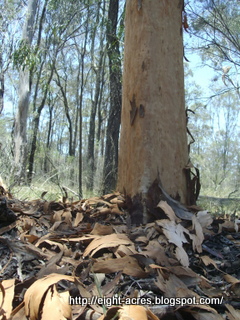 |
| This tree loses its bark in early summer and is called "salmon bark" |
The first principle on the list is Observe and Interact. Obviously I have to start somewhere, but I do need to point out that this is not to say that we only need to apply this principle once at the start of a design, the principles are arranged in a circle because design is a cycle, in which we observe, make a change, and observe again. We need to be continuously observing and interacting with our environment in order to refine and optimise our designs.
Initial observations
We have been very lucky to have had lots of time (almost a year now) to observe our new property before we had to start developing anything. We have spent time thinking about where to put the house and then how to orientate the house. Where to put the shed in relation to the house and then everything else that we want close to the house.
Late last year I joined a permaculture discussion group on Homegrown and as part of that I started a permaculture design for our house yard. The first step was to gather all the data about the climate and landscape. For me, this was even better than just observing the property for a year. We were able to look at data from the previous ten years (since the airport was built nearby) to see how the temperature and rainfall fluctuated between and within years.
In Australia , the best source of climate data is the Bureau of Meteorology (affectionately known as “the bom”). Use this page to find the closest weather station to your property, you can then download the observations as .csv files which you can open in excel and then do a bit of analysis of averages and maximums/minimums.
It is also possible to get the sun path chart for your property if you know the gps coordinates (which you can easily find onine, just google latitude and the name of your town), so you can work out how the sun angle changes with the seasons. The best source that I found was here.
I used a number of different sources to map the property. We have the “property map of assessable vegetation” from the QLD dept of environment (can be downloaded for properties in QLD here, which includes vegetation and waterways), google maps, and my own GPS map. I drew all the important features from these sources onto one survey map (from when we bought the property), so we now have a rough idea of roads, creek lines, dams, fences, distances and paddock areas.
You can find my initial permaculture design observations on my google docs here.
Ongoing observations
The problem with the weather observations is that the property is 10km from the airport where the readings are taken. This means that readings are really only an indication. As much of our rainfall is due to storms, there can be no rain on one property and 50 mL on another close by. We need to keep our own records in order to know the real annual rainfall and temperature variations on our property.
In December I started keeping a detailed diary for the farm(s). I was going to start in January, but then I thought best to just start, and not worry about it being the start of the year or not. I was going to buy a diary, I thought that if I had a special diary that I had paid for, I would feel obliged to use it, but then I couldn’t find a diary that was suitable. In the end I decided to make my own. I just used 3 days per page, with extra space on the Sunday page. A month prints out on 8 leaves of paper, so the entire year (when I print it) will be only 96 leaves. I keep it clipped into a simple folder, and try very hard to fill it in every evening. The most important thing is rainfall and number of eggs, and then any notes about where the cattle are, so we can keep track of when they were moved to different paddocks. At first this is mainly for Eight Acres, as we aren’t at Cheslyn Rise everyday to read the rain gauge, but once I get into the habit of making notes, I hope that it will be easy to continue to observe both properties as I get the opportunity.
Another tip from Linda Woodrow is to name things. Even if you don't know the proper name, if you name something yourself, you will remember it. For example, there is a tree on our property that was in flower in December and I called it our Christmas tree, that will help me to remember when it flowers. It also helped me notice where that tree was growing and how many other similar trees weren't in flower at the time.
An example of the Observe and Interact principle in practice
When we moved to Eight Acres we knew that we had one area in particular that was very badly eroded and seemed to get worse everytime we had a decent rainfall event. When I first heard about swales and hugelkultur I wondered if we could use those ideas to help with our erosion problem. I could see that we needed to fence the area to keep out the cattle (who were just walking all over it and making the erosion even worse), and we needed to do something to prevent more of the bank washing away. First I build a small swale/hugelkultur at the top of the slope, just using logs and piling up grass clippings and mulch. The logs stopped the mulch washing away, and the mulch helped to catch the top soil coming down the hill. I could see that it was working, so I kept expanding the system gradually. I then started to plant arrowroot and comfrey, and anything else that I had spare, to try to generate some more organic matter and start to build up some soil. So far these plants have struggled, and maybe I need to think more about what else I could get established there, its hot and exposed and there's not much soil yet. In some places the Rhodes grass is starting to creep over the bank, which is ideal. Maybe it will take several years to really see an improvement, but at least I think I’ve prevented it from getting worse.
In this simple example, I think I observed the problem, I tried a small system, I observed that it worked and I extended the system further. This is what we need to do at each design stage of our larger property. First observe the cause of a problem, or a possible inefficiency that could become an opportunity for improvement, make a small change, observe the impact and continue to build the system as appropriate.
 |
| before |
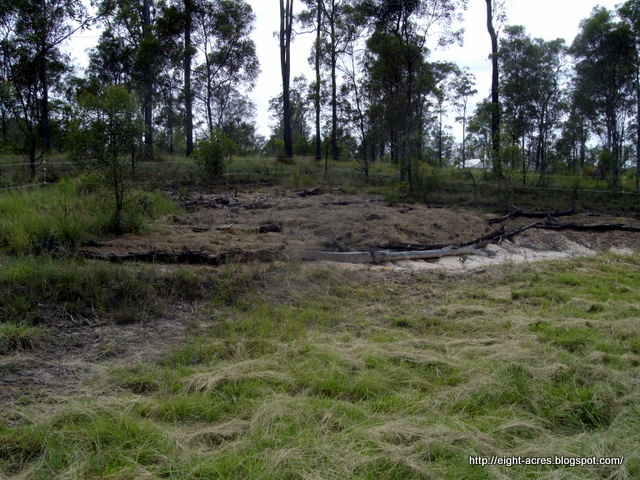 |
| after (different angle, sorry!) |
How have you applied “Observe and Interact” at your place?
:
Observe and Interact
Catch and Store Energy
Obtain a Yield
Apply Self-Regulation and Accept Feedback
Use and Value Renewable Resources
Produce no Waste
Design from Patterns to Details
Integrate, Rather than Segregate
Use Small and Slow Solutions
Use and Value Diversity
Use edges and value the marginal
Creatively Use and Respond to Change
Catch and Store Energy
Obtain a Yield
Apply Self-Regulation and Accept Feedback
Use and Value Renewable Resources
Produce no Waste
Design from Patterns to Details
Integrate, Rather than Segregate
Use Small and Slow Solutions
Use and Value Diversity
Use edges and value the marginal
Creatively Use and Respond to Change
Thanks for your thoughts
ReplyDeleteI like to try to observe and interact with the farm all the time and I really enjoy that intensity.
That change you made to the eroded bank was hugely significant and positive,with that small buffer of the logs and mulch you can use a greater range of plants eg the locals that thrive or even willow weeds
Cheers Pete
An excellent and interesting post. Cheers for sharing your thoughts and your plans (so far) and your ethos. The best thing about permaculture is that it can be picked up and dropped anywhere in the world. It works, and it works because of the series of cycles that are initially put into practice and that eventually work together to facilitate a natural resource management of the property that you are on. Anyone can start with permaculture. It would be ideal if we could all afford rainwater tanks, grey water systems, as much mulch, manure and as many soil conditioners as we could handle but the truth is that permaculture allows you to work within your means, in fact, it actively encourages you to think outside the box to effect the changes that you want and in the process enrich your life and those of our communities. Permaculture opens up a world of possibilities and the fact that people have gone before us and made mistakes that we can learn from and are openly willing to share how to go about it is a precious commodity. It will be really interesting to follow your plan through with you :). Thank you for sharing with us all :)
ReplyDeleteYep. We changed our veggie garden to have a summer and a winter one after watching how the veggies grew. And trying different methods with our fruit trees to see which gave the best result. But the best observation for me was the one I recently posted about. Our land is regenerating all by itself!
ReplyDeleteObserve and Interact works here too and I've posted on my success with prunings around new plantings to keep chooks off/digging etc nothing too exciting
ReplyDeletebut I also find sometimes it sends you on the path to negative thinking. For example (and I've yet to blog this), we went away and were expecting rain while away, so I teed up 'just in case' watering for when I thought it would be needed.
Turns out it was cranky hot and a lot of things looked very very past it when I got back. that's a negative - just two days of no water and things were drying. How arrogant of people to think that they can really be self reliant when we're relying on unreliable (scheme water, electricity) service provision. Certainly not service provision that will be around forever (one day I'll have my block!).
BUT... again from a negative take a positive. I learnt what plants managed that stress well. I learnt how long it takes for some to recover and that some really didn't care. So... combo really.
so yes I do, but what I really really yearn for is to do the 'observe and interact' on our own block...
so in the meantime, research, practice and planning :)
Looking forward to seeing progress of one sort or another, at your place :)
great examples everyone, thanks for the discussion. I'm looking forward to lots of permaculture exchanges this year!
ReplyDeleteThanks for sharing your initial permaculture observation sheet. I like the way you have set it out--concepts always make more sense with examples and this is a real, living example.
ReplyDeletethanks Paul :) glad you found it useful.
Delete